
Bank of Baroda Data Breach: What Happened, Impact, and Key Details You Need to Know

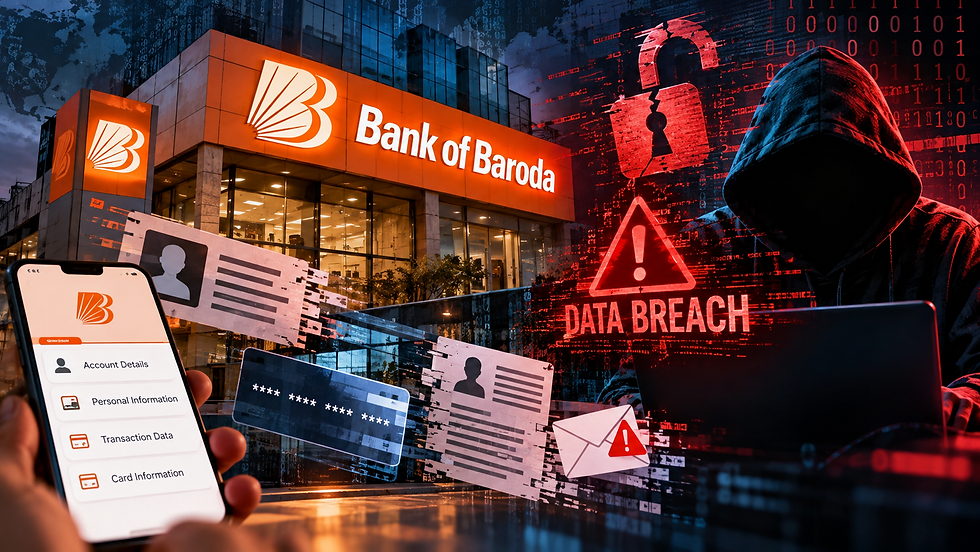
Almost all digital banking services are linked to the internet, as cybersecurity has become crucial to banks. Recently, Bank of Baroda (BoB), one of India’s biggest public sector banks, faced a serious cybersecurity situation after reports surfaced of a bank customer data breach.
The matter concerns millions of BoB’s customers, cybersecurity specialists, and regulators. Though the bank officially denies any compromise of its core banking system, the alleged exposure of information shows once again that a single compromised employee account can pose a serious threat to an institution. A bank data breach of this kind affects trust as much as security.
In this article, you can find all the details of the Bank of Baroda data breach, including how it happened, the data allegedly compromised, the action taken by the bank, the impact on customers, and the lessons that can be learned.
What Exactly Caused the Bank of Baroda Data Breach?
The matter came to light after cybersecurity experts discovered that a cybercriminal group had posted a large volume of BoB customer data and internal documents on the dark web.
At first, the leaked archives were believed to contain more than 700 GB of data. However, cybersecurity experts later estimated the total size at about 1 terabyte (TB). They claimed it included customer data, loan documentation, internal audit files, and other company data.
After the news reached the media, BoB acknowledged the security incident.
According to the bank, the cybercriminals broke in through a compromised employee email account and accessed some information, but customers’ transactions and the core banking system remained safe.
Data Expected to be Allegedly Exposed
An investigation is still underway to determine the full extent of this bank customer data breach, but sources suggest that the leaked data could include:
Customer names
Aadhaar-related information
Information about accounts
Loan-related information
Information regarding customer KYC
Customer’s net banking information
Corporate banking information
NRI banking information
Auditing reports
Customer support information
ATM credentials and details
NOTE: It is worth noting that the Bank of Baroda has not verified all of the data categories listed above.
Was the Customer’s Money Stolen through the Bank Data Breach?
Currently, there is no indication that money belonging to customers was stolen in this bank data breach. That is a significant difference. Even so, cybersecurity experts warn that personal information can remain valuable to cybercriminals even when banking systems stay intact. Stolen personal information can later be used for:
Identity theft
Phishing
Customer care fraud and scams
Social engineering
Loan fraud
Financial impersonation
Therefore, customers need to stay cautious even if nothing happens to their accounts.
Inside the Security Breach: How Hackers Gained Access to the System
As per Bank of Baroda’s official statement, the breach occurred through a compromised employee email account. An employee email account typically holds:
Client communication details
Internal reports
Documents
Attachments
Work records
After gaining access to such an email account, hackers can download as many files as they can, depending on the level of access the particular employee had. From the above example, it is clear that cybersecurity is not just server protection but also relies a lot on:
Awareness of employees
Passwords and privacy protection
Two-factor authentication
Email security
Access control
Bank of Baroda's Response to the Breach
Actions by indian bank on breach of data typically begin with containment and disclosure. After confirming the incident, BoB announced the following:
Forensic Analysis
The bank conducted a forensic analysis to find out how the hackers gained access, which files were exposed, how many data records were compromised, and whether any other systems were affected.
Relevant Authorities Notified
The bank also clarified that it is collaborating with the concerned authorities and cybersecurity agencies.
Secure Core Banking System
BBoB tried to convey the core message that its core banking system is still secure. It also mentioned that customers' transactions are running smoothly and there is no impact on any regular banking operation.
Claim Against Cyber Insurance Policy
Some reports state that BoB has filed a claim under its cyber insurance policy because of the recent bank data breach.
Why This Breach Matters to the Public
Bank of Baroda is one of the largest public sector banks in India. It serves millions of individual customers, corporate clients, government organisations, international customers, and NRI customers. Because of this huge customer base, any bank customer data breach can affect a large number of people. The situation brings into question other concerns, such as data management, cybersecurity spending, access by insiders, risks in digital banking.
Risks that Clients Could Face
Although the attackers might not succeed in withdrawing funds from the customers' accounts, the information stolen may still be used for fraudulent purposes. The risks could include the following:
Phishing E-mails: They might use your e-mails for fraudulent activities by posing as a BoB employee.
Vishing: They might use phone numbers pretending to be from the bank, asking for OTPs or passwords to steal sensitive information.
Identity Theft: Stolen personal information might be used for identity theft purposes.
Loan Fraud: The identity information might be used in fraudulent loan schemes.
SIM Swap Attack: The attack may involve taking possession of the client's SIM card.
Practical Steps Customers Can Take To Avoid
Customers can adopt preemptive measures to ensure safety from such risks in the future. It can make sure most of your data remains secure in case of any fraudulent activity or scam. These may include:
Changing Banking Passwords
Keep changing your Net Banking passwords
Keep updating your Mobile Banking passwords
Email password if reused elsewhere
Two-Factor Authentication
Try to enable multi-factor or two-factor Authentication
Authentication app usage for secure logins
No dependency on SMS OTPs
Review Bank Statement
Regularly keep an eye on your balance and accounts
Keep an eye on every small and big transaction
Update your provided loan details
Credit card transactions
Immediately report any discrepancies in case of any mismatch in details in your bank account.
Be Cautious Against Scams
Never disclose One-Time Passwords received on your contact number or email
Never share your debit/credit card number, date, or CVV
Avoid disclosing your Debit Card PIN to anyone, private or in public
Password for Net Banking
NOTE: Banks never ask for any confidential banking information over a call or message.
Growing Cyber Threats to Banks
The Bank of Baroda case is not the only one to come to light in recent years. Financial organisations around the world have become targets because their datasets hold millions of customers’ identity details, financial data, business information, and government data.
Cybercriminals now use various methods such as ransomware, credential theft, compromised email, supply chain attacks, and social engineering. Attackers increasingly avoid attacking complex banking systems head-on and instead exploit human error to find a loophole.
What this Breach Means for India's Banking Sector
The incident offers valuable lessons for customers and financial institutions alike, and actions by indian bank on breach of data will be watched closely from here on. Key takeaways include:
Employee login credentials must be better secured
Private data requires tight control over its access
There is a need for continuous cybersecurity vigilance at financial institutions
Security awareness training is crucial
Detection of breaches is required as early as possible to decrease the size of loss incurred
With the further development of digital banking systems, customers’ trust needs to be determined by how well their personal data is protected.
Conclusion
The Bank of Baroda data breach demonstrates how much attention cybersecurity issues get in modern banking. It is a relief that the bank’s core banking system has not been impacted, but the alleged exposure of personal data should not be taken lightly either, since hackers may be interested in personal information as much as in money. Therefore, identity theft protection should be of particular concern to the bank’s customers.
As for the customers’ response, staying calm but vigilant, regularly changing passwords, and double-checking all suspicious messages and phone calls seems reasonable. As for the bank’s reaction, the customer data breach serves as a reminder that email security and access control should be at the highest levels. Every data breach of a bank is a lesson that trust is a fragile asset that should be carefully nurtured.
References
Reuters – Customer data from India's Bank of Baroda leaked online, source and researcher say https://www.reuters.com/business/media-telecom/customer-data-indias-bank-baroda-leaked-online-source-and-researcher-say-2026-07-27/
The Times of India – Compromised employee email led to data leak, says Bank of Baroda https://timesofindia.indiatimes.com/business/india-business/compromised-email-led-to-data-leak-says-bank-of-baroda/articleshow/132672980.cms
The Economic Times – Bank of Baroda data breached: Is your account in danger? 7 things you can do to protect your account https://economictimes.indiatimes.com/news/new-updates/bank-of-baroda-data-breached-is-your-account-in-danger-7-things-you-can-do-to-protect-your-account/articleshow/132676958.cms


Comments